
Tajweed Rules for Beginners: A Simple Guide With Quran Examples
A simple guide to the 8 Tajweed areas beginners need first, in the right order, with real Quran examples, common mistakes and a 4 week practice plan.

Tajweed rules tell you how to say every letter of the Quran the right way: where the sound starts, how long it lasts and when it changes. This guide covers the eight areas a new reader needs first, in the order we teach them, with real examples from the Quran you can practise today.
Quick answer: Start with makharij (where each letter comes from), then heavy and light letters, then the rules of Noon Sakin and Tanween, Meem Sakin, Ghunnah, Qalqalah, Madd and the stop signs. Learn one rule at a time, practise it on short surahs you already know, and recite to a teacher who can hear the mistakes you cannot.
What is Tajweed?
The word Tajweed comes from the Arabic root jawwada, which means to make something better. In recitation, it means giving each letter its full right: the correct place in the mouth or throat, the correct quality and the correct length.
Allah tells the Prophet ﷺ in Surah Al-Muzzammil 73:4 to “recite the Quran with measured recitation.” Tajweed is how Muslims have carried out that command for 14 centuries, passing the sound of the Quran from teacher to student.
It matters for a simple reason: one wrong letter can change a word. قَلْب (qalb) means heart. كَلْب (kalb) means dog. The only difference is where the first sound is made.
The Prophet ﷺ said, “The best of you are those who learn the Quran and teach it.” (Sahih al-Bukhari 5027)
Is Tajweed obligatory?
Scholars use two levels here. Studying the theory of Tajweed, with all its terms and categories, is a communal duty: some Muslims in every community must know it in detail. Reciting without clear mistakes that change letters or meaning is expected of every Muslim who recites. Imam Ibn al-Jazari, whose poem Al-Muqaddimah is still the main Tajweed text in madrasas today, wrote that applying Tajweed is a firm necessity.
Some jurists, including many Hanafi scholars, treat the finer points of Tajweed as strongly recommended rather than required. All of them agree on one thing: do your best and keep improving. You can read a detailed scholarly answer on IslamWeb fatwa 454147.
What you need before the rules
Tajweed rules sit on top of basic reading. Before you start, you should be able to:
- Recognise all 28 Arabic letters and their shapes at the start, middle and end of a word
- Read the short vowels: fatha, kasra and damma
- Read sukoon (a letter with no vowel), shaddah (a doubled letter) and tanween (the double vowel at the end of a word)
- Join letters into words slowly without spelling them out
If you cannot do these yet, begin with Noorani Qaida. It teaches all of the above step by step and already introduces some Tajweed without naming it.
The order to learn Tajweed rules
Most beginners get lost because they try every rule at once. This is the order we use with new students, from the rules you hear in every line to the ones you meet less often.
| Step | Rule | Why at this point |
|---|---|---|
| 1 | Makharij (letter exits) | Every other rule depends on the letter being right |
| 2 | Heavy and light letters | Fixes the “Urdu accent” most beginners have |
| 3 | Noon Sakin and Tanween | Appears in almost every verse |
| 4 | Meem Sakin | Short rule, builds on step 3 |
| 5 | Ghunnah | The nasal sound used in steps 3 and 4 |
| 6 | Qalqalah | Only 5 letters, easy win |
| 7 | Madd | Controls rhythm and length |
| 8 | Stop signs (waqf) | Stops you breaking the meaning |
Rule 1: Makharij, where each letter comes from
Makharij are the exit points of the letters. Ibn al-Jazari counted 17 exact points, grouped into five main areas:
| Area | Letters | What to feel |
|---|---|---|
| The empty space (Al-Jawf) | The long vowels ا و ي | Air flows with no blockage |
| The throat (Al-Halq) | ء ه ع ح غ خ | Sound starts deep, middle or top of the throat |
| The tongue (Al-Lisan) | Most letters, from ق to ث | Different parts of the tongue touch different points |
| The lips (Ash-Shafatan) | ف و ب م | Lips close or touch the teeth |
| The nose (Al-Khayshum) | Ghunnah of ن and م | Hold your nose and the sound stops |
Letters Urdu and English speakers mix up most
Many of our students grew up speaking Urdu or Punjabi at home and English at school in the UK, USA or Canada. Urdu uses Arabic letters but gives several of them the same sound. In the Quran, each one is different:
- ث س ص: in Urdu all three sound like “s”. In Arabic, ث puts the tongue tip between the teeth, س is a light “s” and ص is a heavy “s” with the back of the tongue raised.
- ذ ز ض ظ: in Urdu all four sound like “z”. In Arabic, ذ and ظ use the tongue between the teeth (ظ is heavy), ز is a plain “z” and ض comes from the side of the tongue.
- ح ه: both sound like “h” in Urdu. ح is a breathy sound from the middle of the throat. ه comes from the deepest part.
- ع ء: Urdu often drops ع. In Arabic it is a squeezed sound from the middle of the throat, different from the plain stop of ء.
- ق ك: ق comes from the very back of the tongue and sounds deeper. ك is further forward, like English “k”.
Practise these pairs slowly in front of a mirror. If you can only fix one thing this month, fix these letters.
Rule 2: Heavy and light letters
Seven letters are always heavy (tafkheem). Scholars put them in one phrase: خُصَّ ضَغْطٍ قِظْ (kh, s, d, gh, t, q, z). For these, raise the back of your tongue so the sound fills your mouth.
Two letters change between heavy and light:
- The Lam in the name Allah is heavy after a fatha or damma, as in قَالَ اللَّهُ (3:55). It is light after a kasra, as in بِسْمِ اللَّهِ (1:1).
- Ra is usually heavy with a fatha or damma, as in رَبِّ الْعَالَمِينَ (1:2). It is light with a kasra, as in رِجَالٌ (24:37).
All other letters are light. A common beginner habit is making every letter heavy to sound “Arabic.” That is also a mistake.
Rule 3: Noon Sakin and Tanween
A Noon Sakin is نْ, a Noon with no vowel. Tanween is the double vowel at the end of a word ( ً ٍ ٌ ), which sounds like an extra Noon. Both follow the same four rules, and the letter that comes next decides which rule applies.
| Rule | What happens | Letters after it | Example |
|---|---|---|---|
| Izhar (clear) | Say the Noon clearly, no nasal hold | The 6 throat letters ء ه ع ح غ خ | مَنْ آمَنَ (2:62), عَذَابٌ أَلِيمٌ (2:10) |
| Idgham (merging) | The Noon merges into the next letter | ي ر م ل و ن (يَرْمَلُون) | With ghunnah: مَن يَقُولُ (2:8). Without ghunnah: مِن رَّبِّهِمْ (2:5) |
| Iqlab (changing) | The Noon turns into a Meem sound with ghunnah | Only ب | أَنبِئْهُم (2:33) |
| Ikhfa (hiding) | The Noon is half hidden with a nasal sound | The remaining 15 letters | مِن قَبْلِكَ (2:4) |
Idgham happens with ghunnah before ي ن م و and without ghunnah before ل ر. One exception: if the Noon and the next letter are in the same word, as in دُنْيَا, there is no Idgham. Read the Noon clearly.
The most common mistake here is mixing Izhar and Ikhfa: hiding the Noon when it should be clear, or saying it clearly when it should be hidden. Mark each Noon Sakin in a short surah with a pencil and say which rule it follows before you recite.
Rule 4: Meem Sakin
Meem Sakin (مْ) has three rules, and they are easier than the Noon rules:
| Rule | Letter after it | What happens | Example |
|---|---|---|---|
| Ikhfa Shafawi (lip hiding) | ب | Lips lightly close, hold a nasal sound | تَرْمِيهِم بِحِجَارَةٍ (105:4) |
| Idgham Shafawi (lip merging) | م | The two Meems join with ghunnah | وَلَكُم مَّا كَسَبْتُمْ (2:134) |
| Izhar Shafawi (clear) | All other letters | Say the Meem clearly | أَلَمْ تَرَ (105:1), لَكُمْ دِينُكُمْ (109:6) |
Take extra care with Izhar Shafawi before و and ف, as in عَلَيْهِمْ وَلَا. These letters are made with the lips too, so beginners often blend them by mistake.
Rule 5: Ghunnah, the nasal sound
Ghunnah is a sound from the nose, held for about two counts. You hear it clearly on every Noon or Meem with a shaddah:
A simple test: hold your nose while saying the Noon in إِنَّا. If the sound stops, you are making the ghunnah from the right place. Count two steady beats, not one and not four.
Rule 6: Qalqalah, the echo
Five letters bounce with a small echo when they have a sukoon: ق ط ب ج د. They are easy to remember as قُطْبُ جَدٍّ (qutbu jad).
- Inside a word, the bounce is small: لَمْ يَلِدْ وَلَمْ يُولَدْ (112:3)
- When you stop on the letter, the bounce is stronger: الْفَلَقِ (113:1), أَحَدٌ (112:1)
Only bounce these letters when they have a sukoon or when you stop on them. Adding an echo to a letter with a vowel is a common mistake.
Rule 7: Madd, stretching the sound
Madd means stretching a long vowel. The three Madd letters are ا (after a fatha), و (after a damma) and ي (after a kasra). One “count” is about the time it takes to fold one finger.
| Type | When it happens | How long | Example |
|---|---|---|---|
| Natural Madd (Tabee’i) | A Madd letter with no hamza or sukoon after it | 2 counts | قَالَ |
| Joined Madd (Muttasil) | Hamza comes after the Madd letter in the same word | 4 or 5 counts | جَاءَ (110:1) |
| Separated Madd (Munfasil) | Madd letter ends a word and the next word starts with hamza | 4 or 5 counts | إِنَّا أَعْطَيْنَاكَ (108:1) |
| Stop Madd (‘Arid lis-Sukoon) | You stop on a word with a Madd letter before the last letter | 2, 4 or 6 counts | الرَّحِيمِ (1:3) when you stop |
| Necessary Madd (Lazim) | A Madd letter followed by a shaddah or fixed sukoon | 6 counts | الضَّالِّينَ (1:7) |
These lengths follow Hafs from Asim, the recitation used in almost every printed Quran in Pakistan, India, the Gulf, the UK and North America. Choose one length for each type and keep it the same through the whole recitation.
Rule 8: The stop signs (waqf)
Small signs above the line tell you where to stop and where to keep going. Stopping in the wrong place can join two ideas that should be apart. These are the signs in the Madani (Uthmani) print:
| Sign | Meaning |
|---|---|
| مـ | You must stop here |
| لا | Do not stop here |
| ج | Stopping and continuing are both fine |
| صلى | You may stop, but continuing is better |
| قلى | You may continue, but stopping is better |
| ∴ ∴ | Stop at one of the two places, not both |
Many families from Pakistan and India read the 13 line or 15 line Indo-Pak print, often bought in Lahore or Karachi. It has the same rules but uses some extra letters, such as ط, ز and ص, as stop signs. Ask your teacher to go through the signs in the copy you actually use at home.
7 mistakes beginners make (and how to fix them)
- Reading too fast. Speed hides every other mistake. Recite slowly until the rules come without thinking.
- Saying Arabic letters with Urdu sounds. Practise the letter pairs in Rule 1 daily.
- Making the name Allah heavy after a kasra. In بِسْمِ اللَّهِ it should be light.
- Skipping the ghunnah. Every نّ and مّ needs two counts from the nose.
- Bouncing letters that have a vowel. Qalqalah is only for ق ط ب ج د with sukoon.
- Changing Madd lengths in the same surah. Pick a length and keep it.
- Stopping in the middle of a word to breathe. Take a breath at a stop sign or the end of a verse, then start again from a sensible place.
A simple 4 week practice plan
You can start with surahs you already know from Salah. Spend 15 minutes a day, and listen to a trusted reciter before you read each surah yourself.

| Week | Focus | Practise on |
|---|---|---|
| 1 | Makharij and heavy or light letters | Surah Al-Fatiha |
| 2 | Noon Sakin, Tanween and Ghunnah | Surah Al-Ikhlas, Al-Falaq, An-Nas |
| 3 | Meem Sakin and Qalqalah | Surah Al-Fil, Al-Kafirun, Al-Ikhlas |
| 4 | Madd and stop signs | Surah Al-Kawthar, An-Nasr, then Al-Fatiha again |
At the end of each week, record yourself reciting the surah and play it back. Write down the mistakes you hear, and bring them to your next lesson.
Can you learn Tajweed on your own?
Apps, YouTube and colour coded Qurans are useful for revision. They show you the rule. They cannot hear you. Most mistakes in Tajweed are ones the reader cannot hear in their own voice, which is why the Quran has always been learned by reciting to a teacher who corrects you on the spot.
If it feels hard at first, that effort still counts. The Prophet ﷺ said that a person who recites the Quran and finds it difficult, yet keeps going, gets a double reward. (Sahih al-Bukhari 4937)
How long does it take to learn Tajweed?
It depends on your starting point and how often you practise. A student who already reads Arabic letters will usually learn the basic rules faster than someone starting from the alphabet. In our Quran Reading with Tajweed course, adults with five short classes a week usually finish in around 6 to 8 months. Short daily practice works better than one long session a week, because Tajweed is a habit of the tongue, not only knowledge.
Frequently asked questions
Which Tajweed rule should I learn first?
Start with makharij, the correct place each letter comes from. If a letter is wrong, no other rule can fix it. After that, learn Noon Sakin and Tanween, because they appear in almost every verse.
Can I learn one rule at a time and still read the Quran?
Yes. Scholars have advised beginners to keep reading the Quran while they apply one rule at a time and add more as they become comfortable. (IslamWeb fatwa 448186) Do not stop reciting while you wait to learn everything.
Do I need to know Arabic to learn Tajweed?
No. Tajweed is about sound, not meaning. You need to read the Arabic letters and vowels, which Noorani Qaida teaches, but you do not need to speak or understand Arabic.
How many Tajweed rules are there?
Most beginner courses cover about 25 to 30 named rules inside the eight areas in this guide. Advanced study adds more detail, such as the qualities (sifaat) of each letter.
Can children learn Tajweed rules?
Yes. Young children learn by copying the sound long before they learn the names of the rules. Many start Noorani Qaida from age 4 and learn the rule names later, once they read well.
Is a colour coded Tajweed Quran helpful?
It helps you spot rules such as ghunnah, ikhfa and qalqalah while you read. It is a good tool for practice at home, but it does not correct your pronunciation, so use it alongside a teacher.
Is Tajweed different in the Indo-Pak and Madani Quran?
The rules are the same, because both follow the Hafs recitation. The script style and some stop signs are different, so practise from the copy you will use every day.
Can I learn Tajweed online?
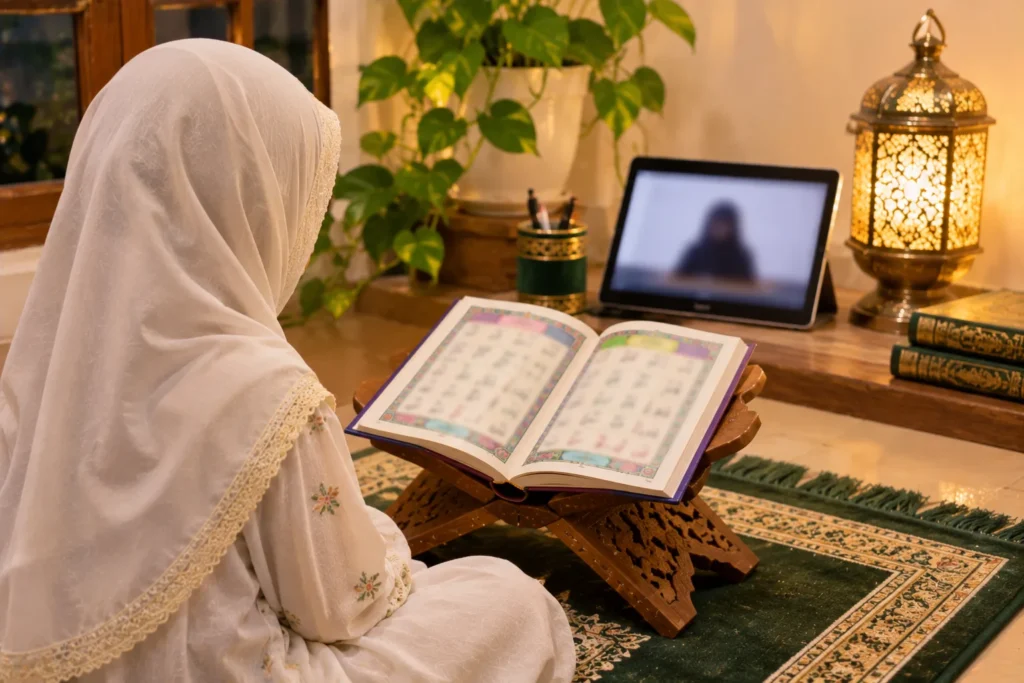
Yes. In a live one to one class, the teacher hears every letter you read and corrects it straight away. On video you can also see clearly how the teacher shapes each sound. Our online Tajweed classes are 30 minutes, Monday to Friday, and the first 3 classes are free.
Start with a teacher who can hear you
Reading about Tajweed rules is the first step. Reciting them out loud to a teacher is how they stay with you. Our certified Hafiz and Hafiza teachers give live one to one lessons on Zoom or Teams, with female teachers for sisters and children.
Your first 3 classes are free, so you can try a real lesson before you pay anything. See the Monthly Fee or message us on WhatsApp to book.